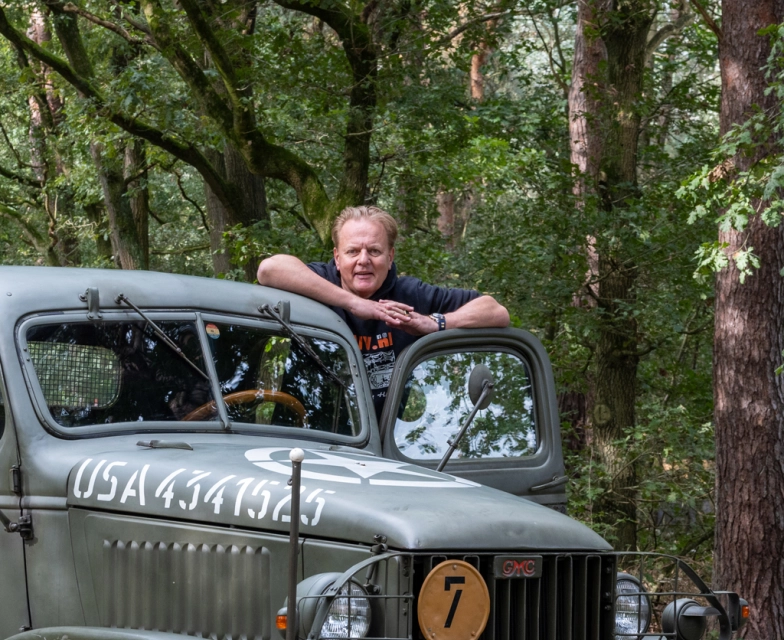
Ivo Rigter Sr.
Founder & Co Owner of BAIV and Tracksandtrade
+31 6 518 22 502 ivosr.rigter@tracksandtrade.com


This stunning DUKW is in great condition, meticulously restored with great attention to detail. The body is in excellent shape and hasn't touched water since restoration. Fully equipped with original items such as the sand anchor, searchlight, toolbox, wheel house fairings, A-frame hoist, this vehicle is the perfect addition to any collection and esspecially for those who enjoy being on the water and have a strong affinity for boating.
Step in, drive, and sail away with this unique DUKW. Are you going to take it for its maiden voyage?
This stunning DUKW is in very good condition, meticulously restored with great attention to detail. Th restoration of the DUKW started in 2019 but and was already good conditions. On top of that all the omega reinforcements are replaced. Bilge pumps and all other accessoiries are in working condition. The body is in excellent shape and hasn't touched water since restoration. Fully equipped with original items such as an anchor, searchlight, toolbox, wheelhouse fairings, and even a (replica) A-frame hoist. The tires of the DUKW have dried out somewhat, and it is advisable to replace them in the near future.
History and Development
The DUKW (also known as Duck) is a six-wheel-drive amphibious modification of the 2+1⁄2-ton CCKW trucks used by the U.S. military during World War II and the Korean War.
Designed by a partnership under military auspices of Sparkman & Stephens and General Motors Corporation (GMC), the DUKW was used for the transportation of goods and troops over land and water. Excelling at approaching and crossing beaches in amphibious warfare attacks, it was intended only to last long enough to meet the demands of combat.
The DUKW was built around the GMC AFKWX, a cab-over-engine (COE) version of the GMC CCKW six-wheel-drive military truck, with the addition of a watertight hull and a propeller. It was powered by a 269.5 cu in (4 L) GMC Model 270 straight-six engine. A five-speed overdrive transmission drove a transfer case for the propeller, then a two-speed transfer case to drive the axles. The propeller and front axle were selectable from their transfer case. A power take-off on the transmission drove an air-compressor and winch.
A high-capacity bilge pump system kept it afloat if the thin hull was breached by holes up to 2 inches (51 mm) in diameter. One in four DUKWs mounted a .50-caliber Browning heavy machine gun on a ring mount.
The DUKW was the first vehicle to allow the driver to vary the tire pressure from inside the cab. The tires could be fully inflated for hard surfaces such as roads and less inflated for softer surfaces, especially beach sand. This added to its versatility as an amphibious vehicle. This feature is now standard on many military vehicles.
Deployment
The DUKW was supplied to the U.S. Army, U.S. Marine Corps and Allied forces, and 2,000 were supplied to Britain under the Lend-Lease program; 535 were acquired by Australian forces, and 586 were supplied to the Soviet Union, which built its own version, the BAV 485, after the war.
Use in War
DUKWs were initially sent to Guadalcanal in the Pacific theater, but were used by an invasion force for the first time in the European theater, during the Sicilian invasion, Operation Husky, in the Mediterranean. They were also used on the D-Day beaches of Normandy and in the Battle of the Scheldt, Operation Veritable, and Operation Plunder. After World War II, reduced numbers were kept in service by the United States, Britain, France, and Australia, with many stored pending disposal. Australia transferred many to Citizens Military Force units. Also many were used after WWII by civilian organizations such as the police, fire departments, and rescue units. Surviving DUKWs have since found popularity among WWII collectors and as tourist crafts in marine environments.
Why buy an amphibious vehicle?
Amphibious vehicles captivate collectors due to their rarity, uniqueness, and historical significance. These distinctive vehicles, capable of seamlessly transitioning between land and water, represent a niche segment in automotive and military history. Collectors are drawn to their unconventional design and engineering, appreciating the innovative solutions required for dual-terrain functionality. Often associated with military applications or iconic moments in transportation evolution, these vehicles become prized additions to collections, showcasing technological advancements and adaptive capabilities. The scarcity of amphibious models contributes to their allure, with enthusiasts relishing the opportunity to own a piece of unconventional automotive heritage. Their dual-purpose nature and ability to evoke a sense of adventure also appeal to collectors seeking distinctive and conversation-starting additions to their portfolios. In the world of collectibles, amphibious vehicles stand out as not just mechanical artifacts but as symbols of ingenuity, versatility, and a bygone era of exploration. The thrill of driving into water, becoming afloat, and then sail off from the shore is a feeling that cannot be described. It needs to be felt!


Ivo Rigter Sr.
Founder & Co Owner of BAIV and Tracksandtrade
+31 6 518 22 502 ivosr.rigter@tracksandtrade.com